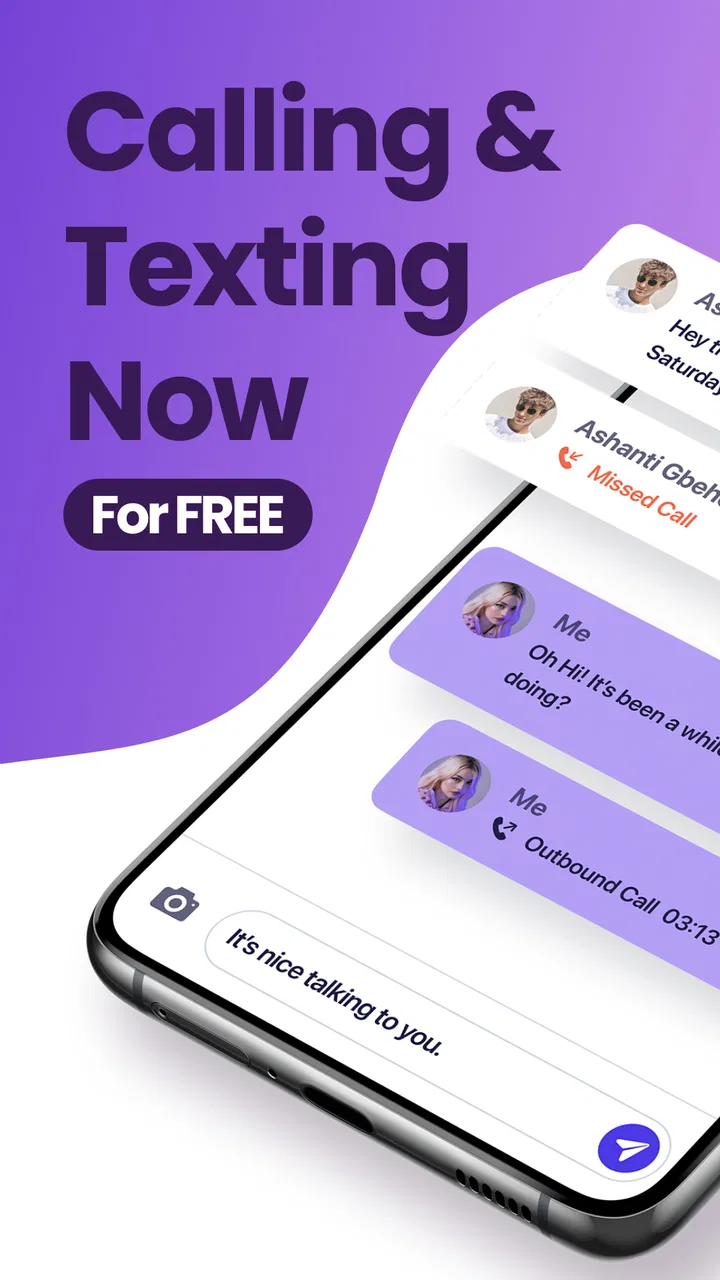
TextNum: Call + Text for Now!
- 4.5
- Rating
- 1.00M
- Installs
- Free
- Price

 Analysis by App-foxy
I tried TextNum: Call + Text for Now! as a communication app from Vidma Video Studio, and my first impression was that it is aimed at a very specific problem: having another number available for texting and calling without replacing the number already tied to my phone. That makes it more interesting than a basic messaging tool, but also less universally useful than a normal SMS app. If you regularly separate personal conversations from temporary contacts, this is the kind of app worth examining closely.
The app is free to install and is rated for Everyone, which keeps the barrier to trying it low. It has reached over a million installs and holds a 4.4 average from around fifteen thousand ratings, so it is not an obscure experiment with no user history. Still, those figures do not tell me whether it fits every situation. A second-number app needs to be judged by reliability, convenience, privacy expectations, and how well it handles the everyday moments when I need a separate line quickly.
How TextNum feels in everyday use
The central idea is straightforward: I can use the app to text from an additional phone number rather than exposing my primary number immediately. That can be useful when I am joining a local group, replying to someone I do not know well, arranging a marketplace exchange, or keeping a side project separate from family and friends. The appeal is not simply having another inbox; it is having a little more control over which identity I use in a conversation.
You May Also Like

 Blood Strike: 2.5 Anniversary
Blood Strike’s Loadouts Turn Every Drop Into a Tactical Gamble
A close look at Blood Strike’s custom loadouts: how fast access to signature weapons reshapes its battle royale rhythm, rewards preparation, and narrows the gap between fights.

 Pandora - Music & Podcasts
Pandora’s Music Is Easy to Start, but Harder to Recover
Pandora’s strength is its low-effort path from a seed to a station. Its weak spot is how much confidence it asks you to place in connection, setup, and quiet recovery.

 8 Ball Pool
 Is Built on Rivalries, Rematches, and Routine
A close look at the rivalries, rematches, shared routines, and unanswered safety questions that turn a quick pool match into a persistent mobile community.

 Samsung Music
’s Quiet Strength Is Playing What You Already Own
Its reach comes less from spectacle than from dependable access to a personal library. That simplicity is both the app’s strongest retention engine and its ceiling.

 AccuWeather: Weather Radar
AccuWeather Review: A Quick, Clear Forecast for Everyday Decisions
For everyday plans, the best forecast is the one you can understand quickly. AccuWeather makes rain timing, radar, and local conditions easy to act on, with a few trade-offs.

 Hill Climb Racing
Why Hill Climb Racing Still Turns Crashes Into One More Run
A tiny car, a bumpy hill and one more upgrade: Hill Climb Racing keeps resurfacing because its simple chaos makes every near-miss feel personal.
More From Our News Desk



In a realistic scenario, I might be selling a desk online. I want to answer interested buyers and coordinate a pickup, but I do not want every stranger to have my personal number. Using a separate number lets me keep those messages away from my regular conversations. After the sale, I can stop using that line for the same purpose and avoid turning a one-time exchange into a permanent connection in my main phone book.
That workflow is where the app makes the most sense. It is not trying to replace every communication service on my phone. Instead, it gives me a dedicated place for conversations that are useful but temporary, public-facing, or better kept apart from my normal contacts. I found that mental separation more valuable than the novelty of simply owning an extra number.
The interface is most useful when I treat it as a focused communication workspace. Before sending a message, I need to be aware of which number is active and which conversation belongs to that line. That sounds obvious, but it is an important habit: a second-number tool only helps if I do not accidentally reply from the wrong identity. I would recommend checking the selected line before starting a sensitive or unfamiliar conversation.
Who gets the most value from a second number
I can see this being helpful for freelancers, people running small side businesses, students organizing activities, and anyone who frequently communicates with people outside their trusted circle. It can also be handy for travel planning or short-term projects where I want a communication channel that does not immediately blend into my personal life.
Parents may appreciate the separation when coordinating with clubs, tutors, or event organizers. A person who works from home might use it for client inquiries while keeping their personal number reserved for close contacts. Even a job seeker could find a separate line useful when responding to listings, provided the service meets the expectations of the people they are contacting.
However, I would not treat it as a guaranteed substitute for a carrier-provided number. Some services verify identities through phone numbers, and some may reject virtual or app-based numbers. That is a practical limitation rather than a defect unique to this app. If I need a number for banking, account recovery, government services, or anything where long-term ownership and guaranteed message delivery are essential, I would choose a conventional mobile line instead.
It is also not the right choice for someone who wants a full replacement for their phone's native calling and messaging experience. The usual phone app and default SMS service are still simpler for people who only need one dependable number. Installing TextNum adds another place to monitor, another identity to remember, and potentially another subscription decision later.
What the current version tells me about its direction
The current version is 1.41.2, while the app was released on November 7, 2024. That combination suggests a product that has already moved beyond its first basic build and is being maintained through successive updates. I see that as a positive sign for an app whose usefulness depends heavily on a smooth, dependable routine rather than a one-time novelty.
I would still separate what is visible today from what I might hope to see next. A newer version number does not automatically mean that every difficult part of second-number communication has been solved. It tells me the product has evolved since launch, but it does not give me a reason to assume that delivery, number availability, or compatibility will be identical for every user and every destination.
For existing users, the practical lesson is to update carefully and then test the actions they rely on most. I would send a message to a trusted contact, check incoming replies, and place a short test call before using the app for an important appointment or customer exchange. This is especially sensible after any update to a communication app, because small changes in permissions, account flow, or notification behavior can have a larger effect than they would in a casual game.
The app's category matters here. As a communication product, it is judged less by visual polish than by whether messages arrive when expected and whether I can understand the state of a conversation. A beautifully arranged screen cannot compensate for uncertainty about the active number or a missed notification. My recommendation is therefore based on the usefulness of the separate-number workflow, not on the assumption that it should replace every other communication method.
Changes and the effect on people already using it
For someone who installed an earlier build, the move toward version 1.41.2 is most relevant if the app has become part of a daily routine. A mature routine usually includes more than sending a message: I need to notice incoming replies, return calls, recognize which contact belongs to the extra line, and decide when a conversation should be moved elsewhere. Any improvement to those basic steps can make the app feel substantially better, even if the underlying concept has not changed.
I would not advise existing users to assume that an update changes the app's role. It remains best understood as a separate communication channel, not a privacy guarantee or a replacement for a carrier relationship. The most useful change for a current user is often consistency: opening the app and immediately knowing which line is available, which chats need attention, and whether a reply came through.
A good habit is to keep the second number out of long-term records unless the relationship genuinely becomes permanent. For a temporary buyer, event contact, or short project, I would label the conversation clearly and review it later. This reduces the chance that I will forget why the contact exists or accidentally continue using the extra line for unrelated conversations. That organizational step is easy to overlook, but it is one of the real advantages of separating communication at the source.
Another useful workflow is to use the app for the first contact, then move an established relationship to the channel that suits both people best. If a client becomes regular, a business email or dedicated business line may be easier to archive and manage. If a group becomes permanent, a normal messaging platform may offer better history and collaboration tools. TextNum works well as a controlled entry point; it is not necessarily the best final home for every conversation.
I also recommend being transparent when the context calls for it. A separate number can protect personal boundaries, but it should not be used to mislead someone about who is contacting them. In normal use, it is simply a practical boundary between parts of my life. That distinction matters because the app can create separation, but responsible communication still depends on how I use it.
Costs, expectations, and the points that need caution
The app is free, but it includes in-app purchases ranging from $1.99 to $49.99 per item. That is the detail I would pay closest attention to before relying on it for a long-term workflow. Free installation makes testing easy, yet the eventual cost of maintaining the number or accessing particular options can matter more than the initial download decision.
My advice is to decide what I actually need before paying. If I only want to test whether a second line fits a short project, I would begin with the free experience and avoid treating the app as a permanent business system immediately. If the number becomes important, I would review the purchase screen carefully, understand whether the charge is one-time or recurring, and compare the total cost with a low-cost carrier line or another established communication service.
The price range also changes who should skip the app. Someone who needs a stable number for years, expects formal customer support, or requires guaranteed compatibility with every verification service may be better served by a carrier or business phone provider. Someone who needs occasional separation and is comfortable managing an app-based communication channel is more likely to find the trade-off reasonable.
There is a second kind of friction: attention. A separate number only works if I remember to check it. If notifications are easy to miss or I rarely open the app, a sender may wait longer than expected. I would not use it as my sole emergency contact method, and I would not assume that every incoming call or message deserves the same urgency as one arriving through my main line.
Before using it for an important conversation, I would test three things with someone I trust: whether an outgoing message identifies the intended number, whether replies appear promptly, and whether calls are easy to recognize. That small test is more useful than relying on the app's general reputation, because my phone settings, network, location, and communication needs may differ from another user's.
How it compares with ordinary alternatives
Compared with the default phone and SMS apps, TextNum offers a clear advantage when separation is the priority. Native tools are usually more familiar and may be better integrated with contacts, call history, and notifications, but they generally revolve around the main number already attached to the device. If I want a distinct identity for a temporary or semi-public conversation, the extra-number approach is more flexible.
Compared with a second physical SIM or eSIM, the app is potentially easier to try because I do not need to change hardware or manage another carrier plan at the outset. The trade-off is that a carrier line may feel more dependable for long-term use, especially when I need broad compatibility, reliable account recovery, or a number I can keep independent of one particular app.
Compared with general internet calling services, this app's appeal is its focused use as a second communication channel rather than a broad collaboration suite. A full messaging platform may be better for group discussions, file sharing, searchable history, or work teams. TextNum is more appropriate when the main requirement is a separate way to text or call and I do not want to introduce a larger social or workplace system.
That comparison helped me place the app correctly. It is not automatically better than the alternatives; it is better at one particular job. If my problem is personal boundaries around occasional contacts, it is worth considering. If my problem is team communication, international calling at scale, business records, or dependable identity verification, I would look elsewhere first.
What I would watch before making it a permanent tool
The most important things I would watch are the everyday signals of reliability: how consistently notifications arrive, how clearly the active number is shown, how easy it is to return a call, and whether the purchase model remains understandable. Those details determine whether the app becomes a calm boundary between conversations or another inbox I have to remember.
I would also watch how well the product serves users who have already built a routine around it. A communication app should make existing conversations easier to manage rather than forcing users to rethink their setup after every change. For me, useful evolution would mean clearer identity handling, dependable access to ongoing conversations, and fewer moments where I have to wonder whether I am using the right line.
At the same time, I would avoid judging future possibilities as current features. The release history shows continued development, but my decision should be based on what the present version actually lets me do comfortably. If a feature is essential to my work, I would test it directly instead of assuming it will arrive in a later update.
One non-obvious benefit is that the app can encourage better communication hygiene. By giving temporary contacts their own space, it becomes easier to review, close, and mentally separate conversations that would otherwise remain mixed with personal messages. That does not replace good contact management, but it can make boundaries more visible. The downside is that the separation can become a liability if I forget to monitor the additional channel.
Another trade-off is speed versus permanence. I can start a separate conversation quickly, but I should not confuse quick setup with a durable communications plan. For a short-term exchange, that is exactly the point. For an ongoing relationship, I would eventually decide whether keeping the extra line is worth the cost and attention compared with moving to a normal phone number, email address, or dedicated business solution.
Overall, I see TextNum as a practical communication app for people who need distance between their main number and selected conversations. Vidma Video Studio has taken a simple idea and developed it into a product with enough traction to deserve a serious trial, while the current version gives existing users a reason to keep evaluating how well it fits their routine. Its strongest feature is not having more ways to communicate; it is having a clearer boundary around when and with whom I communicate.
I would recommend trying it if I needed a second number for marketplace contacts, temporary projects, side work, or other situations where sharing my personal line feels premature. I would skip it if I needed a carrier-grade number for critical verification, permanent business use, or guaranteed availability. The free entry point makes experimentation reasonable, but the in-app purchase range means I would inspect the costs before depending on it.
For me, the final decision comes down to discipline. If I can check the extra inbox, confirm the active number, and use the service for the situations it is designed to handle, it can be genuinely useful. If I want one effortless, universal phone identity, the native phone app or a second carrier line is likely the better choice. TextNum is a focused tool, and it works best when I treat that focus as its strength rather than expecting it to become my entire communication system.
FAQs for TextNum: Call + Text for Now!
01What platforms is TextNum: Call + Text for Now! available on?
TextNum: Call + Text for Now! is available for both Android and iOS devices. You can download the app from the Google Play Store for Android devices or the Apple App Store for iOS devices. Ensure your device meets the minimum system requirements for optimal performance.
02Does TextNum: Call + Text for Now! offer free calling and texting?
Yes, TextNum: Call + Text for Now! provides free calling and texting services. However, the app may offer in-app purchases or premium features that enhance the user experience, such as additional call minutes or ad removal. It's advisable to review the pricing details within the app.
03How secure is my data with TextNum: Call + Text for Now!?
TextNum: Call + Text for Now! prioritizes user privacy and security. The app uses encryption to protect your data and conversations. However, it's always wise to review the app's privacy policy and terms of service to understand how your data is handled and what permissions are required.
04Can I use TextNum: Call + Text for Now! internationally?
Yes, TextNum: Call + Text for Now! supports international calling and texting. However, availability and rates may vary depending on your location and the destination. It's recommended to check the app's international call rates and any potential restrictions before using the service abroad.
05How do I troubleshoot common issues with TextNum: Call + Text for Now!?
If you encounter issues with TextNum: Call + Text for Now!, start by checking your internet connection, as a stable connection is essential for the app. Restart the app or your device if problems persist. For persistent issues, consult the app’s help section or contact customer support for assistance.
Pros
- User-friendly interface and easy navigation.
- Affordable pricing for premium features.
- Supports both calls and texts seamlessly.
- Quick setup with minimal configuration.
- Secure data encryption for privacy.
Cons
- Limited customization options for users.
- Occasional delays in message delivery.
- Requires a stable internet connection.
- Advertisements in the free version.
- Limited customer support response time.

TextNum: Call + Text for Now!
Gallery